
Are We Loosing the Human Touch in Customer Service?
The Rise of AI in Customer Communication
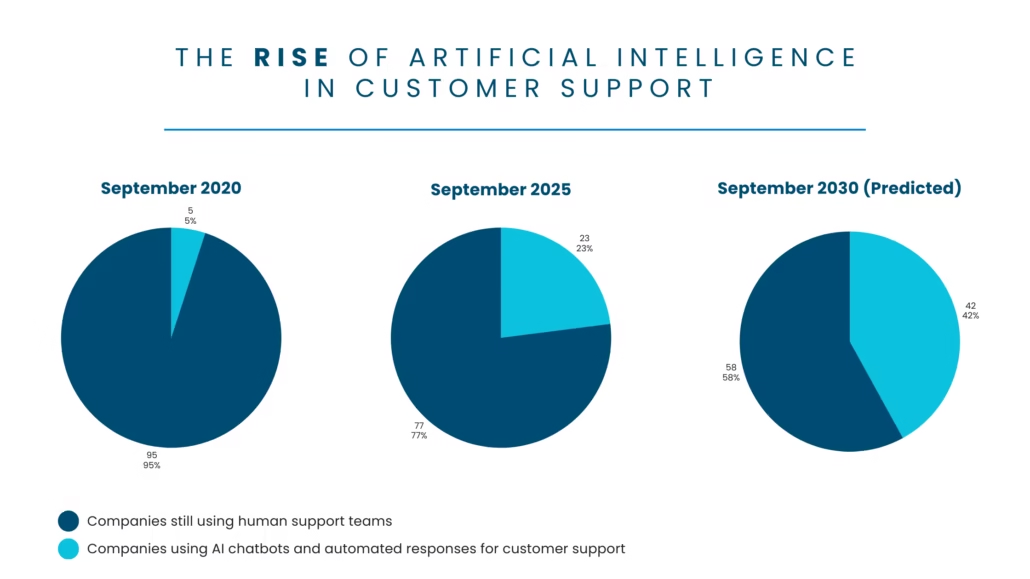
AI is rapidly transforming the way businesses communicate with their customers, with automated responses and chatbots becoming a normal website offering for many businesses. These features have quickly enabled companies to provide their customers with fast, 24/7 support very easily. It’s no surprise that in September 2025, nearly a quarter (23%) of UK businesses use AI in customer service.
Major organisations such as Amazon have already embraced AI to streamline support services, and chatbot usage is expected to increase even further in the coming years.
Whilst artificial intelligence offers an extreme level of efficiency and convenience, customer relationships still remain crucial, especially for small businesses, where personal interaction often provides a foundation for long-term success.
The Benefits of AI Communication
There is no doubt that AI offers significant advantages when it comes to customer communication, due to its ability to provide faster and more efficient customer service responses.
For larger and growing businesses, AI can be useful in managing high quantities of enquiries, freeing up their workforce to focus on more complex customer needs. In some cases, AI can produce more accurate responses to queries, reducing the risk of human error misinforming customers.
Cost savings are another key reason many companies invest in AI tools. Automation of routine tasks results in a reduction of operational costs whilst still maintaining a high level of availability.
While these advantages make AI an attractive solution for many organisations, they represent just one side of the customer service experience.
The Problems with AI Customer Service
However, AI-driven customer service isn’t without its challenges. While automated systems can improve efficiency, many customers report frustration when dealing with AI-powered support.
Having to repeat information, being stuck in loops and reaching dead ends are all common complaints that have been reported. Instead of resolving issues quickly, chatbots can sometimes create additional barriers between customers and the support they need, particularly when queries fall outside standard responses. In some cases, businesses deploy AI systems to deflect enquiries rather than resolve them, focusing on automation rates instead of customer satisfaction.
This can lead to a service experience that feels impersonal and inefficient, where speed is prioritised over understanding. As a result, customers may find it easier to access automated support than to speak to a real person, which can negatively impact overall satisfaction and trust.
Why Human Interaction Still Matters
Despite advances in AI, human interaction remains essential to delivering high-quality customer service. Customers often value being able to speak to a real person, particularly when dealing with complex issues or situations that require reassurance and understanding.
Human conversations allow for flexibility, natural communication, and the ability to respond to individual needs in a way that automated systems often cannot replicate.
In smaller companies, especially, strong customer relationships are built on trust and personal connection. Taking the time to understand a customer’s situation helps to create a more positive experience and encourages long-term loyalty. Personal service can make the difference between a satisfied customer and a lost one, as people are more likely to return to businesses that they feel heard by.
Empathy and understanding are also difficult to automate. While AI can provide quick answers, human interaction allows for genuine support, problem-solving, and reassurance. By maintaining a strong human element in customer communication, businesses can build lasting relationships that go beyond simple transactions and contribute directly to higher customer satisfaction.
To Conclude...
AI will continue to play an important role in customer service as businesses look for ways to improve efficiency and provide faster support. Automated systems and chatbots offer clear advantages, particularly when it comes to handling high volumes of enquiries and providing round-the-clock availability. However, automation shouldn’t replace human connection entirely, especially when customer satisfaction and long-term relationships are at stake.
The most effective approach may be a balance between technology and human interaction, where AI supports customer service teams rather than replacing them. By maintaining personal communication alongside automated tools, businesses can ensure that customers still feel understood and valued.
In the end, customer satisfaction depends on more than efficiency alone. While AI can enhance the speed and accessibility of support, it is human interaction that builds trust, strengthens relationships, and creates positive customer experiences that last.